During the season, you can harvest and enjoy in-season fruits (raspberries, blackberries, apples, pumpkins and pears), vegetables (squash, carrots, zucchini, potatoes, eggplant, corn and beans) and herbs (basil, chives, dill and parsley).
Nothing tastes better than homegrown produce! If you’re interested in growing your own vegetable or herb garden, start with what you’re interested in growing, determine how big of a space you have to plant and do a little research about the best approach and timing.

When the City plans maintenance or construction work in a particular street or neighborhood, it’s crucial to keep residents and homeowners informed about the process.
To ensure that residents and homeowners are well-informed about upcoming maintenance work that may affect their properties, the City follows a notification process. Notices are distributed via hand-delivered letters, and here’s how it works:
Hand-Delivered Letters: The City prepares notification letters detailing the planned maintenance work and its potential impact. These letters are hand-delivered to the residents and homeowners. In some cases, when work affects businesses, staff will personally enter the premises to drop off the notices.
Timeline: The City strives to deliver these notices at least one week before the commencement of the work. This advanced notice allows residents and homeowners to make necessary preparations or adjustments to accommodate the upcoming construction.
Extenuating Circumstances: While the City aims for timely communication, there can be extenuating circumstances. For instance, if the scope of work expands after the crew has started, staff will make efforts to notify residents on-site about the changes. The goal is to keep everyone informed and minimize disruptions.
Before any construction work begins, it’s essential to ensure that underground utilities and infrastructure are marked to prevent accidental damage. Here’s how the City handles locates:
Contractor Responsibility: The responsibility for obtaining locates falls on the contractor hired to perform the construction or maintenance work. They must request locates from the Ontario One Call service, which acts as a central point of contact for locating underground utilities.
Utility Locates: Once contacted, each utility company is obliged to locate their underground infrastructure within the specified work area. This step is crucial for the safety of both the construction crew and the existing utilities.
Timing: Contractors usually request locates well in advance of the scheduled work. This practice is based on past experiences where delays in obtaining locates have occurred. This proactive approach ensures that locates are ready when construction work is scheduled to start.
The City is committed to keeping residents and homeowners informed about upcoming maintenance and construction work that may impact their properties. While there may be instances of long-term delays, these are often part of the preparation process to ensure the work is completed efficiently and safely.
Whether you’re late for an appointment or work, rushing to pick up your kids from school or trying to get home to catch the game…speeding isn’t the answer. The faster a car moves, the higher its risk of being involved in a collision. Speeding is one of the biggest contributors to collisions on Mississauga roadways, which can cause fatal or life-changing injuries. The City of Mississauga is reminding drivers to be aware of the posted speed limits and obey the rules of the road.
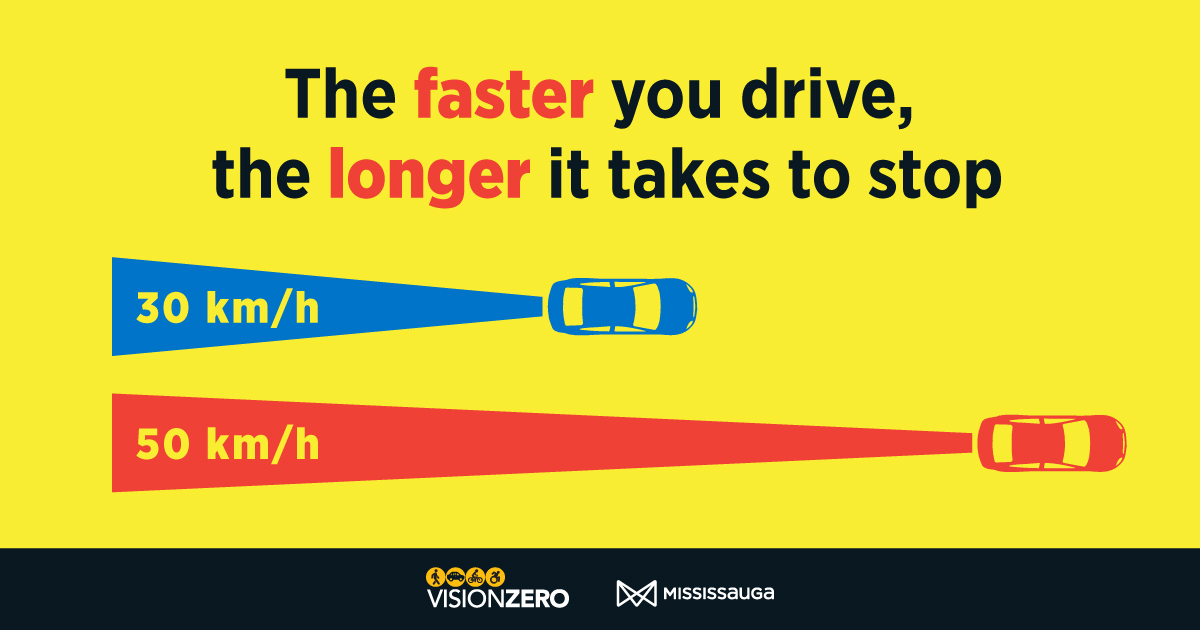
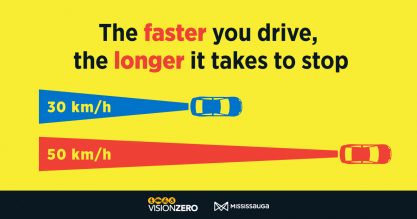
“The faster you drive, the longer it takes for you to stop,” said Geoff Wright, Commissioner, Transportation and Works. “Driving fast reduces your time to think and react to an unexpected situation. Imagine driving, and a child darting out onto the road. If you were speeding, could you stop in time? This could mean the difference between life, death or a life-changing injury. This is why we’re focusing on addressing speeding in Mississauga to keep residents safe. The City has adopted the Vision Zero goal, which aims to eliminate all fatalities and serious injuries on roadways due to collisions.”
According to data from Peel Regional Police, between 2015 to 2019, approximately 700 serious collisions were caused by aggressive driving, including speeding, on City-owned roads in Mississauga.
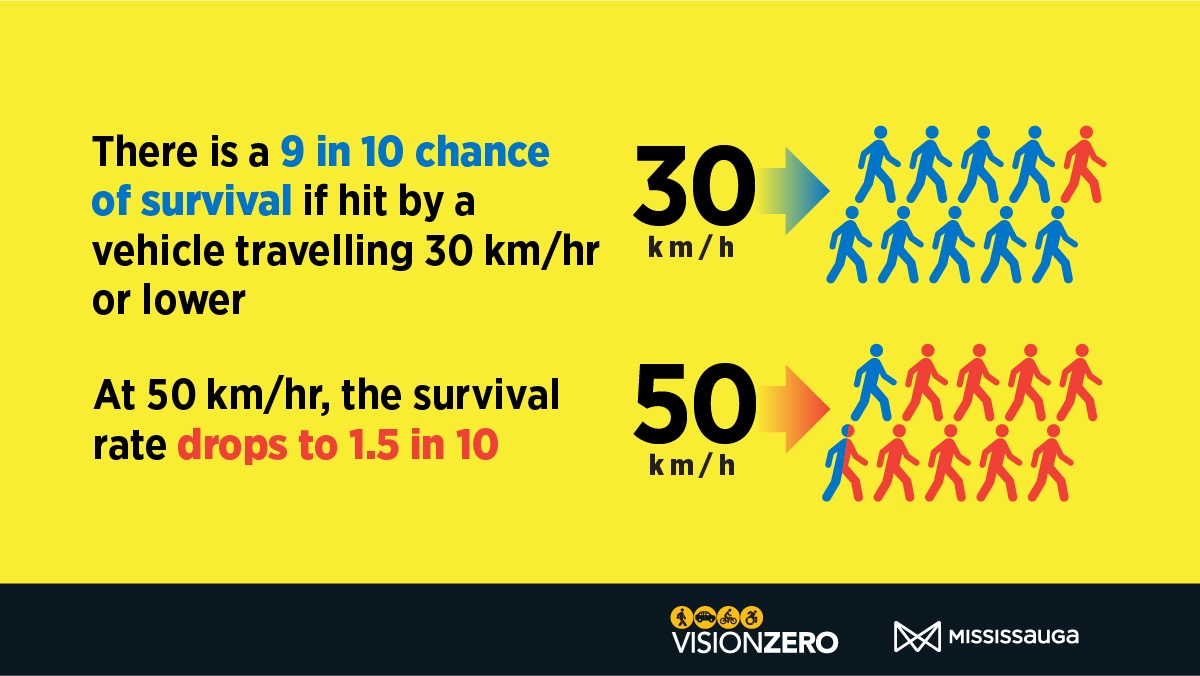
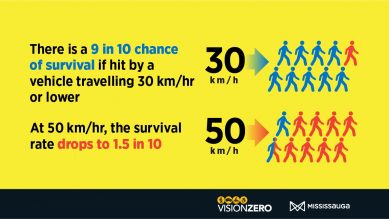
“Driving 20 km/h faster than the posted speed limit might not seem like a big deal, but research shows that if you hit a pedestrian while driving 50 km/h, their survival rate is less than 20 per cent. In comparison, at 30 km/h, their survival rate is 90 per cent,” said Laura Zeglen, Program Lead, Vision Zero. “As a driver, you control how fast you drive. Remember, driving the posted speed limit and to weather conditions is not only for your safety, but also the safety of others on the road.”
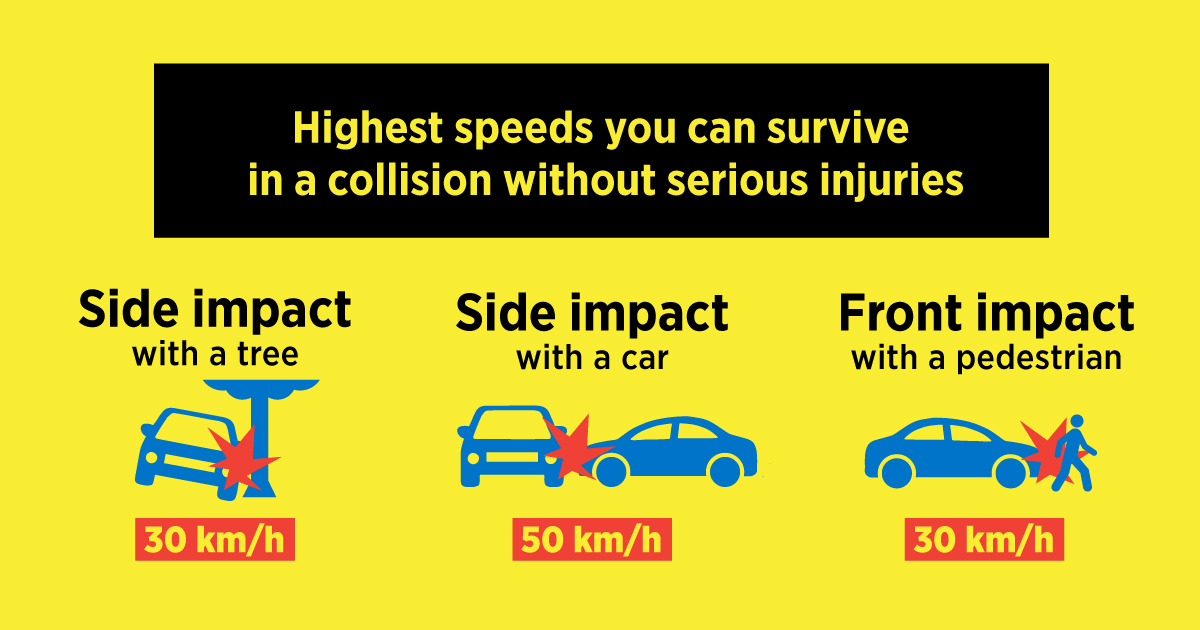
According to the Transportation Association of Canada, the maximum speed to prevent serious injury or death in an impact with a pedestrian is 30 km/h. The maximum speed to prevent serious injury or death in a collision with another car is 50 km/h.
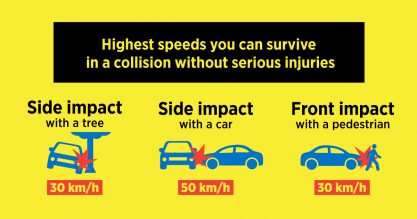
The City is working with its community partners to address speeding to raise awareness about the dangers of speeding, educate drivers on slowing down and inform the public about new measures to slow down drivers. Here are some of the measures which have been implemented to prevent speeding and protect vulnerable road users including pedestrians and cyclists:
- Installed speed humps or raised pedestrian crossings
- Rotated 22 speed cameras to different school zone locations
- Lowered speed limits in neighbourhoods, school zones and City-owned roadways posted at 70 km/h
To learn more about how the City is encouraging drivers to slow down and other Vision Zero initiatives and actions, visit mississauga.ca/visionzero.
If you see a vehicle involved in dangerous and aggressive behaviour, you can report it to Peel Regional Police’s Road Watch program online: https://www.peelpolice.ca/en/report-it/make-a-report-online.aspx#What-types-of-reports-can-I-file-online
Background
Vision Zero aims to create safer roads for everyone in Mississauga. In 2021, the City of Mississauga launched its Vision Zero Action Plan with 99 actions to help reach Vision Zero. Vision Zero is a long-term goal of zero fatalities and serious injuries due to collisions on roadways that countries around the world have adopted. The plan provides City staff with actions to apply to their current, ongoing and future projects to help reach Vision Zero.

Halloween can be extra scary for children (and the parents of children) with food allergies!
“The Teal Pumpkin Project” is here in support of children with life-threatening food allergies
A teal pumpkin let’s allergic goblins know you have peanut/nut free and non-food treats like glow sticks, stickers and spider rings…
This is very important to 1/13 of our ‘trick or treaters’…both at school and when trick or treating in their neighbourhood…who must always be on ‘high alert’ for their safety.
Be sure to check local stores and online where products like these are sold.
We can also all make a difference by ‘shelling out’ on the driveway so children with mobility issues can easily ‘trick or treat’.
Be safe and have fun!
October is Pedestrian Safety Month. As daylight hours shorten this fall, the City and Peel Region are reminding all road users to be aware and stay alert when using roads to prevent collisions. As part of International Walk to School Month, the City is also encouraging students to walk and use other forms of active transportation as a healthy and fun way to get to school.
- Implementing Pedestrian Head Start Signals and Bike Head Start Signals to give pedestrians and cyclists a five-second head start to cross the street.
- Continuing to install pedestrian crossovers in neighbourhoods to help increase safety for pedestrians crossing the road. Drivers must stop if a pedestrian is in the crosswalk.
- Lowering speed limits from 70 km/h to 60 km/h on City roadways.
- Installing Slow Streets as temporary traffic-calming devices to remind drivers to slow down and be aware of other roads users.
- Continuing the School Walking Routes Program to encourage active travel like walking, biking, using a wheelchair or other mobility devices, to and from school.
- Continuing the School Crossing Guard Program with crossing guards at more than 160 locations to help elementary school students safely cross the road.
“Pedestrian Safety Month highlights the importance of making safer choices when walking, cycling, and driving. Together with our municipal partners, we share common messages to help keep our community safe and encourage all road users to practice extra caution when travelling,” said Kealy Dedman, Commissioner, Public Works at Peel Region. “By reinforcing these essential messages, we are reminding all road users of the need to work together to improve road safety and help support the Vision Zero goal of reducing injuries and fatal collisions on Peel roadways.”
Walk to School Month
October is also Walk to School Month in Mississauga. Students and their families are encouraged to join the One Walk a Week challenge. As part of the challenge, students can try walking or rolling to or from school or their bus stop at least one day more per week than they do normally. Those who participate can go online and complete a digital certificate to share their accomplishment on social media using the hashtag #WalktoSchoolSauga.The City is encouraging all students and their families to walk or bike to and from school. If you live farther from the school, consider parking five to 10 minutes away from the school and walking the rest of the way. Walking or biking promotes healthy lifestyles, reduces traffic congestion and lowers carbon emissions.
Did you know the City of Mississauga delivers more than 200 services including public transit, fire and emergency services, libraries, recreation programs, snow clearing and parks?
In addition, the City also invests in building, maintaining, rehabilitating and remodelling infrastructure such as roads, bridges, trails, stormwater facilities, sidewalks and more.
Watch the City’s social media channels to stay informed about upcoming Budget Committee dates to review the proposed 2024 Budget.
Here are some of the investments made in the 2023 Budget that are already underway:

A pro forma is a fundamental analysis tool used by condo developers to determine whether to proceed with a project. It involves specifying project details such as unit count, square footage, and average unit size, along with essential financial components like gross residential revenue, net residential revenue, total project revenue, project costs (including both hard and soft costs), and net profit. Ultimately, developers utilize the pro forma to gauge the potential profitability of their project through a preliminary estimate.
- When looking at purchasing a site, developers tend to work backwards to determine how much they should pay for property.
- Developers who assume higher densities in their pro forma will often pay more for a site.
- Hard costs associated with construction have escalated over last few years and municipalities have minimal control over these.
- Municipal growth related charges such as development charges and parkland dedication are used to pay for new infrastructure to support growth. Costs for the construction of municipal infrastructure has also increased in recent years.
- Other soft costs include consulting, architectural, sales commissions and similar expenses.
- Unit sale prices are determined by the market.

What can we do to reduce the rates of Diabetes in Mississauga?
We want to hear from you
The City is looking to hear from as many community members and businesses as possible. Your input is critical to the success of this strategy.
Survey: Complete the online survey before Thursday, November 30, 2023.
The City will also engage in conversations with various communities throughout Mississauga, focusing on those with an increased risk of type 2 diabetes. A health equity lens will be applied to ensure the needs of those most impacted by diabetes are considered, which would support changes that will benefit all citizens.
The City will work with the community, industry, agency and government partners to understand Mississauga’s unique type 2 diabetes challenges, identify community needs and priorities, build the strategy and determine the action plan.
Visit the City of Mississauga’s type 2 diabetes online engagement site for more details and to sign up for project updates.